Wearable & Lifelogging Cameras
Ray-Ban Meta vs Insta360 GO 3S for Hands-Free Capture
Ray-Ban Meta vs Insta360 GO 3S for hands-free capture: glasses or tiny clip camera, privacy, battery, storage, and travel use compared in 2026 today.
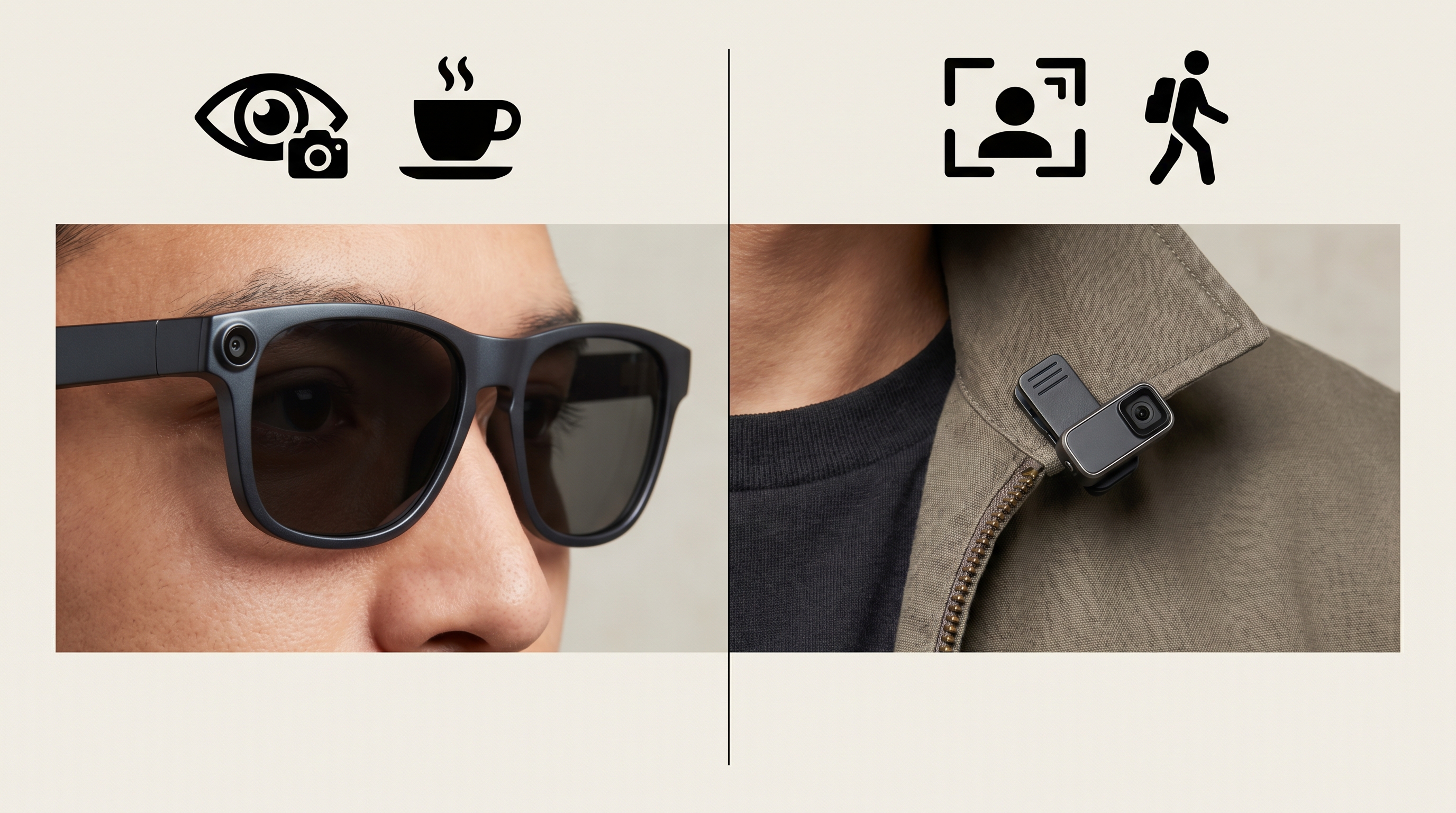
Ray-Ban Meta vs Insta360 GO 3S is a choice between two different ideas of hands-free capture. The Ray-Ban Meta glasses are the camera you wear because they look like something you would wear anyway. The Insta360 GO 3S is the camera you wear because it is small enough to mount almost anywhere. One is socially smooth and cloud-heavy. The other is more camera-like and more archive-friendly. Neither is a true Narrative Clip successor, and neither should be treated as a passive recorder for everyone around you. The right choice depends on whether your real use case is quick POV moments, travel journaling, creator clips, or local-first memory capture. This comparison favors practical ownership over hype: what gets recorded, where the files go, who notices, and what still works if the app changes.
Why this comparison matters now
Hands-free capture is finally mainstream enough that the question is no longer “does this work?” It is “what kind of compromise do you want?” Ray-Ban’s official Meta glasses page lists camera, audio, AI, storage, and battery features in a normal eyewear package. Insta360’s official GO 3S page sells a tiny 4K camera with an Action Pod, magnetic mounts, and creator-friendly capture modes.
Those products overlap in search results, but not in lived use. Glasses are for quick first-person moments. The GO 3S is for intentional POV capture without the bulk of a GoPro. A traveler might use either. A parent might use either. A creator might use either. But the archive produced by each device feels different.
The deeper reason this comparison matters is cloud dependency. Smart glasses are becoming AI devices, not just cameras. Tiny cameras are becoming app-connected creator tools. Both can drift toward account-bound workflows if buyers do not pull files into their own archive. The lesson from The Clip Story still applies.
What to evaluate before choosing
Evaluate how you want to wear the camera. Ray-Ban Meta lives on your face. That is convenient, but it means every capture is face-direction POV. The GO 3S can be clipped to a shirt, hat, strap, pendant, bike, kitchen shelf, or table. If the angle matters, the GO 3S wins.
Evaluate what you want to record. Ray-Ban Meta is made for photos, short clips, open-ear audio, and assistant interactions. The GO 3S is made for video-first capture. Its user manual documents waterproofing of the camera unit and the relationship between the camera and Action Pod, while Ray-Ban and Meta documentation emphasizes AI, audio, and social sharing.
Evaluate the cloud. Meta’s multimodal AI system card explains that captured images and spoken text can be passed to AI models in smart-glasses use. Insta360 has an app ecosystem too, but the GO 3S is easier to treat as a camera that produces files.
Evaluate bystanders. A camera on glasses can feel less obvious than a camera on a shirt. That is not always a benefit. The GO 3S is tiny, but when mounted visibly it reads more like a camera. Both require restraint.
Comparison table: Ray-Ban Meta vs Insta360 GO 3S
| Criterion | Ray-Ban Meta | Insta360 GO 3S |
|---|---|---|
| Best role | Daily eyewear, quick POV photos, short clips | Tiny mounted camera for travel and POV |
| Mounting | Face only | Magnetic clip, pendant, hat, stand, Action Pod |
| Archive workflow | App and account-centered | Easier to copy files into your archive |
| Audio | Open-ear speakers and mics | Camera audio, not an earbud replacement |
| Privacy signal | Capture LED | Visible if mounted deliberately |
| Weakness | Cloud/account dependence | Short core battery without pod |
Affiliate disclosure: This page contains affiliate links. If you buy through them, we may earn a small commission at no extra cost to you. It never changes what we recommend. As an Amazon Associate I earn from qualifying purchases. Read more.
Product comparison and workflow
Capture experience
Ray-Ban Meta wins on readiness. If the glasses are on your face, the camera is aimed. That is excellent for fleeting moments. It also makes the device easy to overuse because capture feels like a voice command or tap rather than a decision.
The GO 3S wins on camera craft. Put it on a shirt for walking POV, on a hat for higher perspective, on a pendant for casual capture, or in the Action Pod when you need a screen. It asks for more setup but rewards it with more useful angles.
Travel
For travel, the choice depends on the kind of trip. City wanderers who want a few hands-free memories may prefer Ray-Ban Meta. People building a travel journal with clips, time-lapses, and mounted sequences should buy the GO 3S.
The GO 3S also has the advantage of looking less like an AI assistant. In some countries and spaces, that matters. Smart glasses can draw questions at security or in museums even when you are not recording.
Family and daily life
Glasses are socially smoother but ethically heavier. A child may forget the glasses have a camera. Guests may not notice the LED. The wearer has to announce capture clearly. The GO 3S, mounted visibly, is easier to point at and explain.
For family memories, we prefer a visible camera and fewer clips. Record the cake, not the whole party.
Storage and editing
The GO 3S is easier to fold into a local archive. Copy files, sort by date, back them up, edit later. The Insta360 app may be useful, but it does not need to be the permanent home.
Ray-Ban Meta media should be imported to the phone and then backed up through your normal workflow. Do not leave the important copy inside a social-sharing path. If a clip matters, it belongs in Storage & Backup, not just in an app gallery.
AI and assistant value
Ray-Ban Meta has a real advantage if you want AI features, open-ear audio, calls, and hands-free interaction. The GO 3S does not compete there. It is a camera.
That difference clarifies the purchase. If you want smart eyewear, buy smart eyewear. If you want a tiny camera, buy a tiny camera. Do not buy one expecting it to become the other.
Real-world file workflow
With Ray-Ban Meta, the clean workflow is import to the phone, save anything important into the normal photo library, then let your phone backup handle it. Do that often. The risk is that quick clips feel disposable, so they never get promoted into the archive until the app or phone is replaced.
With the GO 3S, the clean workflow is more camera-like. After a session, copy files from the camera or Action Pod, put them in a dated folder, and only then make edits in the Insta360 app. The app can produce useful reframed clips, but the originals should already be safe.
For both products, add a small review habit. Once a week, pick the best five clips, delete obvious junk, and add a text note if the context will not be obvious later. Future you will not remember why a ten-second hallway clip mattered unless present you leaves a clue.
Which one is less annoying after two weeks?
The glasses are less annoying to wear. The GO 3S is less annoying to own as a camera. That distinction is the whole comparison. Ray-Ban Meta disappears into a daily routine until the app, account, privacy setting, or social context needs attention. The GO 3S takes more physical handling, but the files feel more like normal camera files once the session is over.
If you abandon devices because charging and transfers annoy you, glasses may survive longer. If you abandon services because accounts and clouds annoy you, the GO 3S is the safer bet.
That is also why the cheaper-looking choice may not be cheaper. The device you actually use and export from wins.
Unused capture gear is the expensive option.
Best fit by use case
Choose Ray-Ban Meta for quick POV capture, travel snapshots, open-ear audio, and an assistant you will actually use. It is the better everyday wearable.
Choose Insta360 GO 3S for travel journaling, creator POV, local-first archiving, flexible mounting, and longer capture with the Action Pod. It is the better camera.
Choose neither if you need rugged chest-mount action. Read DJI Osmo Action 5 Pro vs GoPro HERO13 Black instead.
Choose your phone if image quality matters more than hands-free convenience. For many people, the phone plus a better habit wins.
Privacy and backup note
Both devices can be used responsibly. Both can be used badly. The rule is context: announce recording indoors, avoid ambiguous capture around strangers, and move important files into a real archive. The glasses are not a diary if Meta is the only place the workflow makes sense. The GO 3S is not private just because it is small.
For the wider framework, read wearable camera privacy, the best wearable cameras guide, the best lifelogging cameras guide, and the Memory Tech Brief.
Frequently asked questions
Ray-Ban Meta vs Insta360 GO 3S: which is better?
Ray-Ban Meta is better for quick social POV photos, short clips, open-ear audio, and daily wear. Insta360 GO 3S is better for flexible mounting, longer capture sessions with the Action Pod, travel journaling, and cloud-optional file handling.
Which is better for lifelogging?
The Insta360 GO 3S is closer to a lifelogging camera because it can be mounted on clothing and handled like a camera file source. Ray-Ban Meta is easier to wear, but it is built around short intentional captures and Meta's app ecosystem.
Which is more private?
Neither is automatically private. Ray-Ban Meta has a capture LED but is worn on the face and tied to Meta services. GO 3S is more file-oriented and cloud-optional, but it is small enough to be overlooked if used carelessly.
Which should travelers buy?
Buy Ray-Ban Meta if your priority is quick hands-free snapshots and open-ear audio. Buy Insta360 GO 3S if your priority is travel journaling footage, flexible mounts, and a cleaner archive workflow.