Narrative Clip Archive
Narrative Clip: The Original Lifelogging Camera
The complete history of the Narrative Clip, from the 2012 Memoto Kickstarter through the 2016 cloud shutdown, and what to buy instead today.
There is a specific feeling we associate with the Narrative Clip, and it isn’t nostalgia. It’s the small, particular weight of a 20-gram square pinned to a shirt collar, ticking off a photo every thirty seconds, all day, with no screen, no shutter sound, and no way to know what it had just seen. Backers who got their units in 2014 were the first people in history to walk around producing 6,000 photographs a week without thinking about it. Most of those photos lived briefly on a cloud that no longer exists.
We run narrativeclip.com now, an independent editorial site. We are not Narrative AB and we are not the successor company Third Dot. We took the domain over because the conversation the Clip started, about wearable cameras and passive memory and what happens to your photos when a startup turns off the lights, is still useful. Maybe more useful now than it was in 2014.
This is the long version of that story.
Timeline
- Oct 2012Memoto Kickstarter launches
Three founders in Linköping, Sweden ask for $50,000 to build a tiny wearable camera.
- Nov 2012Campaign closes at ~$550k
About 2,871 backers fund the project, one of the year's biggest hardware Kickstarters.
- 2013Renamed to Narrative AB
A trademark conflict forces the rename. The product becomes the Narrative Clip.
- Late 2013 – 2014First Clips ship
Backers begin receiving the 5 MP, 30-second-interval, USB-only Clip 1. Public launch follows at $279.
- Feb 2015Narrative Clip 2 announced
8 MP, Wi-Fi, Bluetooth, GPS, video, and roughly 30 hours of battery. $199 introductory pricing.
- Late 2015 / early 2016Clip 2 ships
Backers and customers receive the second-generation hardware after the usual Kickstarter delays.
- Late 2016Cloud shutdown announced
Narrative, now under Third Dot AB, gives users a window to download their photo archives before the service goes dark.
- End of 2016Cloud and apps retired
The companion apps stop functioning at scale and the Clip's primary value disappears with the servers.
A Kickstarter in Linköping
In October 2012, three Swedes in Linköping launched a Kickstarter for a camera the size of a postage stamp. Martin Källström, Oskar Kalmaru, and Björn Wesén called the company Memoto and the product the Memoto Lifelogging Camera. The pitch, which is still readable in the campaign archive, was direct: a 20-gram square that takes two photos a minute, all day, every day, and uploads them to a service that turns them into something searchable.
They asked for $50,000. They got roughly $550,000 from about 2,871 backers. The campaign closed on November 22, 2012 as one of the most-funded hardware campaigns of that year.
It is easy, in 2026, to read this as obvious in hindsight. It was not obvious. The iPhone 5 had just shipped. Google Glass was a developer prototype. Snapchat was a year old. The category of “wearable camera that records your life automatically” did not exist outside of academic papers by people like Gordon Bell at Microsoft Research, and the hardware that did exist looked like a hospital bracelet. Memoto looked like a piece of clothing.
What caught fire wasn’t only the device. It was the idea that you might want this at all.
The early press read the campaign as the first plausible consumer answer to a research question that had been kicking around since the mid-2000s. If you could capture everything you saw, with no friction, would you actually want it? Most of the academic prototypes had said yes, cautiously, with footnotes about storage and consent. Memoto said yes, confidently, for $279, shipping by spring. The footnotes came later.
The rename
In 2013, a separate company called Memoto filed a trademark complaint. The Swedish team renamed the company Narrative AB and the product became the Narrative Clip. By the time the first units started shipping to backers in late 2013 and through 2014, the brand had already moved on from the name people had pledged to.
That’s a small detail, but it matters. The community that funded the device was buying Memoto. They received Narrative. The product was the same; the social object was slightly different. There’s a version of this story in which that rename slowed the Clip’s word-of-mouth momentum just enough to matter.
The Clip 1
The original Clip, in your hand, was an odd little object. A 36 mm square, around 9 mm thick, about 20 g, with a stainless-steel back clip strong enough to hold to a shirt placket or a coat lapel. No screen. No visible shutter button on top. One lens, set behind the front face. A double-tap on the housing would take an extra photo on demand. Otherwise it just ran.
The sensor was 5 megapixels. The cadence was a photo every thirty seconds. The internal storage was 8 GB, which the company quoted as roughly 6,000 photos. The battery lasted about two days of typical wear before you had to dock it.
Docking is the right verb. The Clip had no Wi-Fi and no Bluetooth. To get photos off it, you plugged it into a USB port on a computer running the Narrative desktop app. The app pulled the photos, sent them to the Narrative cloud, and the cloud did the work of clustering them into “moments” you could scroll through on your phone. The companion mobile app was the only practical way to actually look at what you had captured.
Launch price in the US was $279.
A few things stand out about this design now. The first is that there was no LED to signal recording. Critics flagged this at launch as a consent problem, and Narrative published an ethics post in 2014 acknowledging the issue without really solving it. The reasoning at the time, more or less, was that an indicator light would defeat the point of unobtrusive lifelogging. That argument did not age well, and it shows up almost word-for-word as the thing every newer wearable camera (the Ray-Ban Meta included) has had to find a different answer to.
The second is that essentially every interesting feature of the product happened server-side. The Clip itself was a sensor and a small flash chip. The product was the cloud. Album generation, the timeline view, the “moments” clustering that turned a Tuesday afternoon’s 480 photos into a few representative scenes — all of that was Narrative’s servers doing work that no 20-gram device in 2014 could have done on its own.
The Clip 2
In February 2015, Narrative announced the Clip 2. It started shipping to Kickstarter backers and customers in late 2015 and into 2016 with the usual Kickstarter-shaped delays.
The Clip 2 fixed the obvious things. The sensor went from 5 MP to 8 MP. The field of view widened to roughly 86 degrees. The device got Wi-Fi and Bluetooth, so it could pair directly with a phone instead of needing a desktop. It added GPS, so each photo carried location data. It added short video capture. Battery life stretched to about 30 hours of active use.
Launch pricing was around $199 introductory, with some reports putting full retail at $279.
What didn’t change was the model. The Clip 2 still depended on Narrative’s cloud to do anything useful at scale. The companion app was still the lens through which you experienced the photos. The hardware was sharper; the structural problem underneath was the same.
Why it failed
This is the section we want to be honest about, because the Narrative Clip is often written off as a curiosity, and it was more than that.
The Clip was caught between three things at once. Smartphones were becoming the default camera in a way that absorbed almost every casual capture use case the Clip was designed for. Cloud compute and storage, even in 2015, cost real money per active user; the Clip’s two-photos-a-minute cadence pushed those costs up faster than a typical photo app. And the subscription revenue Narrative needed to fund all that compute never materialized at the scale the company needed.
Hardware-as-a-service is hard. Hardware-as-a-service from a Kickstarter-funded Swedish startup competing with the iPhone in someone’s pocket is harder still.
It’s tempting to say the Clip was ahead of its time. We think the more accurate framing is that the Clip’s premise (passive, automatic capture of everyday life) was correct, and the business model around it was the part that didn’t survive contact with the market. Two photos a minute, all day, for two days on a charge. That math always pulled toward the cloud, and the cloud always pulled toward a bill the users weren’t paying.
The 2016 shutdown
In late 2016, Narrative (by then operating under successor Third Dot AB) emailed users that the cloud service and apps were being retired. Customers were given a window to download their photo archives. The cloud went dark by the end of that year, with the final cut-off bleeding into early 2017 depending on the source.
What users lost depended on what they had done. If you had been diligent about exporting photos during the wind-down window, your archive survived. If you had trusted the cloud the way the product asked you to, and never pulled a local copy, your photos went with the servers.
The hardware still works, in the narrow sense that a Clip plugged into a USB port will still produce a folder of JPEGs. But the album view, the moments, the search, the timeline — all of that lived on Narrative’s servers, and none of it came back. The companion apps stopped being updated and effectively disappeared from the stores. A few enthusiasts have tried to reverse-engineer the photo format and the Bluetooth pairing in the years since, with limited results. Nobody, as far as we have seen, has rebuilt the moment-clustering logic that made the product feel like anything more than a folder of small JPEGs.
This is the lesson the Clip leaves us. A device that depends on a cloud service for its primary value is, in practice, a subscription you didn’t sign up for. When the company writing the checks for that cloud goes away, the device’s main feature goes with it. There is no fallback.
We have spent the years since 2016 watching the same pattern recur. OPKIX did something very similar with its lipstick-sized wearables. Smart-home gadgets do it constantly. The Clip was an early, clean case study of a much wider problem.
What modern wearables learned, and didn’t
The category did not die. It mutated.
The closest thing to the original Clip’s everyday wearability in 2026 is the Insta360 GO 3S. It is a 39-gram pebble that snaps magnetically through your shirt and shoots 4K video. The Ray-Ban Meta smart glasses are the closest thing in social positioning, a daily-wearable hands-free camera that doesn’t read as a camera. Both products learned different lessons from the Clip’s failure, and neither learned all of them.
Compare wearable cameras
Swipe sideways to see all columns →
| Camera | Best for | Resolution | Battery | Mounting | Cloud | Approx. price | Buy |
|---|---|---|---|---|---|---|---|
| Insta360 GO 3S Insta360 | Hands-free lifelogging and POV creators who want the smallest possible 4K camera. | 4K/30 | 0.65 h | Magnetic clip | Optional | $400 | Check price ↗ |
| GoPro HERO 13 Black GoPro | Creators who need a single durable camera for vlogs, sports, and occasional hands-free use. | 5.3K/60 | 1.5 h | Multi-mount | Optional | $400 | Check price ↗ |
| DJI Osmo Action 5 Pro DJI | Creators who shoot long sessions and want better battery and low-light than GoPro. | 4K/120 | 3 h | Multi-mount | Optional | $350 | Check price ↗ |
| Ray-Ban Meta Smart Glasses Ray-Ban / Meta | Daily wearers who want POV photos and short clips without holding a camera. | 1080p/30 | 4 h | Glasses | Required | $300 | Check price ↗ |
| AKASO Brave 7 AKASO | Budget-conscious buyers and first wearables for kids/family. | 4K/30 | 1.5 h | Multi-mount | Optional | $140 | Check price ↗ |
| DJI Osmo Pocket 3 DJI | Travel vloggers who want stabilized, low-light-capable footage without a wearable. | 4K/120 | 1.6 h | Multi-mount | Optional | $520 | Check price ↗ |
Prices and specs are publisher estimates — verify at the retailer before buying.

Insta360 GO 3S
The closest modern relative to the Narrative Clip's everyday wearability — 4K, magnetic clip, and a separate dock for longer captures.
Best for: Hands-free lifelogging and POV creators who want the smallest possible 4K camera.
Review note: The strongest Narrative Clip-style recommendation because it combines a tiny magnetic body, usable 4K footage, and an offline file workflow when you want one.
Pros
- Pebble-sized, ~39 g — clips magnetically through clothing
- 4K/30 video and FlowState stabilization
- Action Pod dock works as a remote viewfinder and extends battery
- IPX8 splash and shallow-water rating on the core unit
Cons
- Battery on the core unit is short on its own — best paired with the dock
- Wide fixed lens; no optical zoom
- Editing flow assumes the Insta360 app
The GO 3S is the one we point Clip-curious readers to most often, with a caveat. It is built around action and creator workflows, not 30-second-interval lifelogging. You can wear it like a Clip, but the software is not trying to give you a passive scrollable archive of your week. It is trying to give you clips you’ll edit. The form factor is right; the philosophy is different.
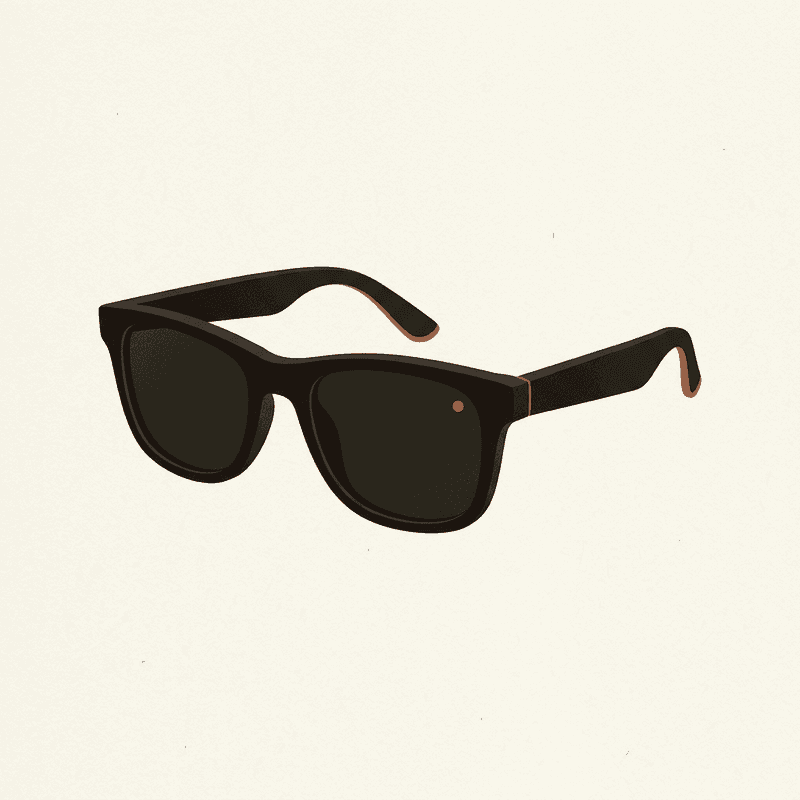
Ray-Ban Meta Smart Glasses
A socially acceptable hands-free camera you can wear daily — quality is good, but cloud and AI features lean on Meta accounts.
Best for: Daily wearers who want POV photos and short clips without holding a camera.
Review note: The best daily-wear option for quick POV photos and short clips, held back by Meta account dependence and limited local-first control.
Pros
- 12 MP ultrawide; up to 1080p video
- Capture LED signals recording to bystanders
- Works as Bluetooth headphones and AI assistant
- Looks like normal sunglasses
Cons
- Short clips only; not designed for hours of continuous capture
- Tied to Meta View app and account
- Limited control over local-only workflows
The Ray-Ban Meta glasses are the more philosophical heir. They are passive, hands-free, and worn daily. They have a capture LED, which solves the consent problem the original Clip never did. They are also tied tightly to Meta’s account system and the Meta View app, which is a different version of the cloud-dependency problem the Clip ran into. The Clip’s failure mode was “the company folded.” The glasses’ failure mode would be “your Meta account is suspended.” Different shape, same family of risk.
The third heir, which nobody likes to admit, is the smartphone. Most people who would have bought a Clip in 2014 now leave their phone face-down on a restaurant table and let Google Photos or Apple Photos build the album. It is a less elegant solution than a 20-gram square that does nothing else, but it is the one that won.
What to do today
A few practical notes for the two audiences who land on this page.
If you have an old Narrative Clip in a drawer, the most useful thing you can do is pull whatever is still on its internal storage to a computer you control, and then make sure those files are backed up somewhere that isn’t a single hard drive. A Clip’s flash chip is over a decade old at this point. They do fail.
The modern workflow after the Clip
The old Narrative Clip captured fragments. Modern workflows also need narration, transcription, search, and storage. A tiny camera can still catch the moment; the system around it has to turn that moment into something you can find and understand later.
That is where an AI audio workflow can help. ElevenLabs is not the new Narrative cloud. It is a narration and audio tool you can add after exporting the files, writing a script, and deciding what should be shared.
Try ElevenLabsAdd narration after the archive is safeDo not clone or replace the voice of anyone in old clips without explicit permission. Preserve the original audio separately from any AI-edited version.
Local backup checklist
A photo archive that lives only on a vendor's cloud is a photo archive waiting to disappear. Use the 3-2-1 rule: three copies, two media, one off-site.
For a longer walkthrough see how to back up lifelogging photos and local-first photo storage.
If you are curious about lifelogging because you remember the Clip and you want to try the idea now, we would suggest one of two paths. The cheaper one is to use the phone you already own. Set Google Photos or Apple Photos to back up automatically, accept that you won’t get the 30-second-interval feeling, and use what you have. The more interesting one is the Insta360 GO 3S, with the understanding that you are building your own lifelogging workflow on top of a camera designed for something adjacent.
We do not recommend buying a used Narrative Clip on eBay, except as a souvenir. The cloud is gone. The apps are gone. The hardware is, charitably, a paperweight that takes photographs.
The Clip wasn’t bad. It was early, and it was lonely on the market, and it depended on a server room that someone was eventually going to have to turn off. Most of what it tried to do is still worth doing. Just not, in 2026, with the device that tried first.
Frequently asked questions
Is the Narrative Clip still sold by its manufacturer?
No. The Narrative Clip has not been manufactured or officially sold since the company wound down operations in 2016. Used units occasionally surface on eBay, but they are essentially keepsakes. The cloud service the device relied on no longer exists.
Can I still use a Narrative Clip I have in a drawer?
Only partially. The hardware can capture photos and you can pull files off the internal storage by plugging it into a computer, but the companion apps and cloud-side album generation are gone. The day-to-day experience that defined the product is no longer available.
Why did the Narrative Clip shut down?
Several reasons stacked up at once. The product depended on cloud compute the company had to keep paying for, recurring revenue from users was thin, and smartphones with always-on cameras absorbed most of the casual market. By late 2016 the cloud was retired and the team had moved on under Third Dot AB.
What's the closest modern equivalent to the Narrative Clip?
There is no exact replacement. The Insta360 GO 3S is the closest in form factor, a tiny magnetic-clip camera you can wear all day. For passive, glanceable capture without holding anything, the Ray-Ban Meta smart glasses come closest in spirit, though both work very differently from the original 30-second photo cadence.
Can I recover photos that were only ever on the Narrative cloud?
Unfortunately, no. The Narrative and Third Dot cloud services were retired in 2016, and there is no path we know of to retrieve archives that were never downloaded during the wind-down window. If your photos are still on the Clip's internal flash, you can pull them off over USB.
Was Memoto the same product as the Narrative Clip?
Yes. Memoto was the original company and product name from the 2012 Kickstarter. A trademark conflict in 2013 forced a rename, and the company and device became Narrative AB and the Narrative Clip. Same hardware, same team, new branding.