Privacy, Ethics & Practical Use
Wearable Camera Privacy: A 2026 Practical Guide
Wearable cameras raise real privacy concerns for the wearer and everyone around them. Here's a practical guide to law, etiquette, and design in 2026.
A friend of mine walked into a yoga studio in 2024 wearing a pair of Ray-Ban Metas. He had forgotten he was wearing them. The instructor noticed the small white capture LED inside the rim before he did, asked him to take them off, and then asked him to leave. He apologized, complied, and was embarrassed for a week. Nobody had been recorded. The hardware did its job. The wearer did not.
That story is the whole article in miniature. Wearable cameras sit at the intersection of three things that don’t always agree: what the device makes possible, what the law allows, and what the people around you have agreed to. Get any one of them wrong and the other two won’t save you.
The wearer is responsible. Full stop.
This is the part that gets argued away most often, and it shouldn’t. If you press record, you own what happens next. Not the manufacturer. Not the venue. Not the friend who told you the glasses were fine to wear. You.
That sounds obvious until you notice how often the framing slides. “The camera was on by default.” “It has a light, so people know.” “I forgot it was running.” All true, all irrelevant. A wearable camera is a tool, and the person wearing it is the one making decisions about what it points at and what happens to the file.
The reason we have to keep saying this is that hardware is getting better at hiding the fact that it’s hardware. The Ray-Ban Metas look like sunglasses. The Insta360 GO 3S is the size of a thumb. The Narrative Clip, when it was sold, was a 36 mm square that weighed about 20 grams and took a photo every 30 seconds without telling anyone. The smaller the device, the more important the wearer’s judgment becomes, because the device is doing less of the social signaling for them.
Hardware that helps
Some design choices make consent easier. They don’t replace the wearer’s judgment, but they raise the floor.
The clearest example on the market right now is the capture LED on the Ray-Ban Meta. It’s small, it’s white, it’s on the front of the frame, and it lights up whenever the camera is active. Meta added it because the first prototypes without it scared regulators and journalists; the company chose, sensibly, to make it required rather than fight that fight. It is not perfect. People can miss it across a room. But it exists, it works, and it cannot be turned off by the wearer.
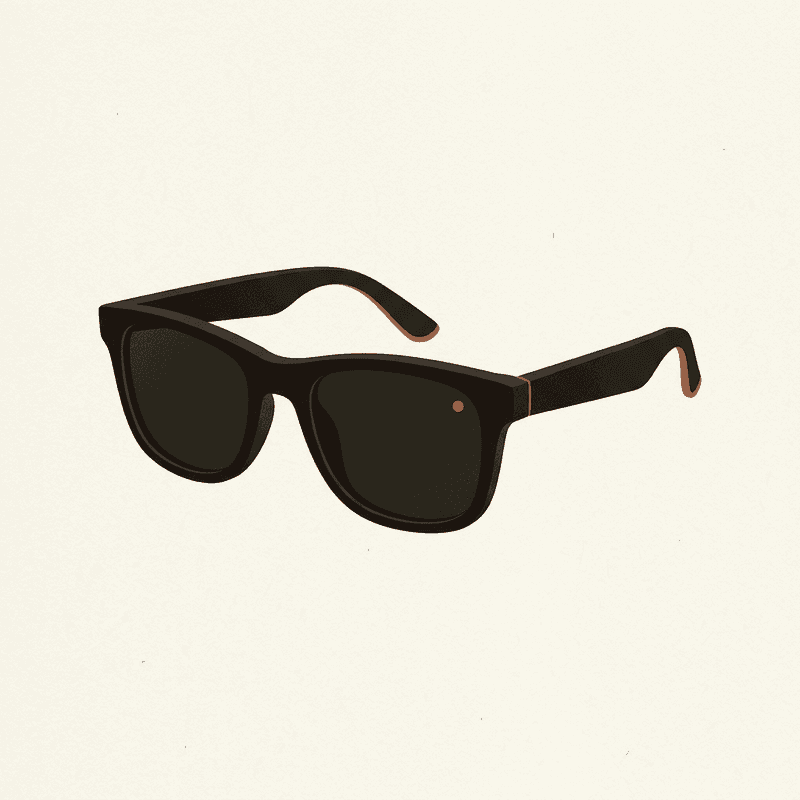
Ray-Ban Meta Smart Glasses
A socially acceptable hands-free camera you can wear daily — quality is good, but cloud and AI features lean on Meta accounts.
Best for: Daily wearers who want POV photos and short clips without holding a camera.
Review note: The best daily-wear option for quick POV photos and short clips, held back by Meta account dependence and limited local-first control.
Pros
- 12 MP ultrawide; up to 1080p video
- Capture LED signals recording to bystanders
- Works as Bluetooth headphones and AI assistant
- Looks like normal sunglasses
Cons
- Short clips only; not designed for hours of continuous capture
- Tied to Meta View app and account
- Limited control over local-only workflows
The Insta360 GO 3S has a status LED on the pebble and another on the Action Pod dock. Most action cameras — the GoPro HERO 13 Black, the DJI Osmo Action 5 Pro, the AKASO Brave 7 — are large enough that they are recording-positive by design. You can see the lens. You can hear the start-stop beep. The form factor itself is the warning sign.
Audible signals help too. A camera that beeps when it starts recording is a camera that is harder to use covertly. Visible cameras, in general, are privacy-positive even when they capture more data than a hidden one would. The Hollywood image of a “security camera” is doing useful work: everyone in the lobby knows what it is.
Hardware that doesn’t help
The other half of the market exists, and it is worth being honest about. There are pen cameras. There are button cameras. There are entire categories of glasses sold on marketplaces specifically because they record without telling anyone they’re recording. There are smartwatches with hidden lenses. There are USB chargers that are cameras.
We do not recommend any of them. Not because they are always illegal — they often aren’t — but because the only practical use case is recording people who have not consented. That is a thing the law occasionally permits and the social contract almost never does. If your reason for buying a camera starts with “they won’t know it’s there,” you have already lost the argument before you’ve spent the money.
The legal layer (briefly, and verify locally)
A short tour. None of this is legal advice. We’ve written more on this in Is lifelogging legal?; the very short version follows.
United States. Video in public is broadly legal. Audio is where it gets sharp. Federal law is one-party consent, but eleven or so states — California, Florida, Pennsylvania, Illinois, Massachusetts, Washington, Maryland, Montana, New Hampshire, Connecticut, Nevada at times — require all parties to a private conversation to consent. The map shifts; check your state.
European Union. The GDPR treats personal recordings as personal data. The “household exception” gives individuals a lot of room for purely private use, but as soon as recordings are shared or published the analysis changes. National wiretap laws sit on top of this and vary widely. Germany is strict. The Netherlands is strict. France is strict in different ways.
United Kingdom. RIPA covers interception. The ICO publishes practical guidance for personal CCTV and body-worn cameras that is the closest thing in Europe to a plain-English wearer’s manual. Worth reading once.
Everywhere else. Australia and Canada largely follow a state/province-level patchwork. Japan has strong norms against covert photography and laws to match. Singapore prosecutes. Brazil’s LGPD echoes GDPR. Some Gulf states treat any recording of a person without consent as a serious offense. If you travel with a wearable, look it up before you land.
The social contract
Laws are the floor. The actual day-to-day of wearing a camera is governed by something older and softer: what is and isn’t rude. A workable etiquette, drawn from people who have done this for years:
Ask. First time you’re in someone’s home, first time at a dinner, first time in a meeting. Once is enough. They don’t have to agree.
Point. When the camera is on you and the person can see it, they can decide. Make it visible. If your shirt is hiding the clip, move the clip.
Signal. Use the LED. Use the beep. If your device doesn’t have one, you are doing the signaling work yourself.
Turn it off in obvious places. Locker rooms. Bathrooms. Schools where you don’t have a child enrolled. Medical settings. Therapy. Anywhere with children who are not yours. Religious services if the venue hasn’t said yes. Funerals unless the family asks. Anywhere a sign on the wall says no.
We have a longer take on this in Wearable camera consent and a practical day-to-day version in How to use a wearable camera responsibly.
The Narrative Clip lesson
The Narrative Clip was the canonical case study. It was tiny — 36 mm square, around 20 grams, no display, no obvious lens, and no LED that announced an image was being captured. It took a photo every 30 seconds, automatically, all day. The company knew this was a problem. In 2014, Narrative published a public ethics post on the topic. They wrote about it thoughtfully. They never solved it.
They didn’t solve it because the social problem was bigger than any single product decision. A camera small enough to forget you’re wearing is a camera small enough to forget to mention. The company chose unobtrusiveness as a feature, and unobtrusiveness was exactly the problem.
In the end, the Narrative experiment ended because the cloud service shut down in 2016, not because the social contract caught up. The cameras stopped working before they stopped being controversial. That’s not progress; it’s an accident.
What we’d want from manufacturers in 2026
A short list, written as if anyone is listening:
A capture LED that cannot be turned off by the wearer. Software switches that disable indicator lights are a privacy red flag, full stop. The Ray-Ban Meta gets this right. Most action cams get this right. Some apps for cheaper devices get it wrong.
An audible signal at the start and end of every clip, with a setting to make it louder, never quieter than the factory default.
Per-session timers and visible state. If a camera is recording for forty minutes, the wearer should know. So should the people they’re with.
A clear, public stance on covert use. If your product is being sold with marketing copy about “discreet” capture, you’ve answered the wrong question.
The companies making wearable cameras already know all of this. Some have made the choices. Some have made the other choices. The wearer’s job, for now, is to choose the ones that took the social problem seriously, and then to keep doing the work the hardware can’t do.
Frequently asked questions
Is it legal to wear a camera in public?
In most countries, recording video in a genuinely public space is legal because no one has a strong expectation of privacy there. Audio is a different question, and so are private venues like shops, gyms, and schools, which can set their own rules. Treat the legal floor as the start of the conversation, not the end.
Do wearable cameras have to have a recording light?
There's no universal law that says so, but specific products do. The Ray-Ban Meta glasses have a required capture LED, and most action cameras have status LEDs by design. Body-worn cameras used by police are often required by policy to have visible indicators. For consumer wearables, it remains the manufacturer's call.
Can I record audio with a wearable camera?
Audio is the part that gets people in trouble. Many US states are 'two-party consent,' meaning every party to a conversation has to agree before it can be recorded. Several European countries treat covert audio recording as a wiretap offense even in semi-public spaces. If you're unsure, mute the mic.
What's two-party consent?
It's the rule that everyone involved in a private conversation has to know about and consent to it being recorded. California, Florida, Pennsylvania, and Illinois are the well-known examples in the US. The opposite is 'one-party consent,' where only one participant (often you) needs to agree.
Should I tell my friends I'm wearing a camera?
Yes. Once. Mention it the first time it's relevant, point out the device, and offer to take it off in conversations they want to keep off the record. After that, the social contract handles itself. People who have been told once and reminded with a visible camera have effectively given soft consent.
Are smart glasses different from a body cam legally?
Legally, mostly no — the same recording, wiretap, and privacy laws apply. Socially, they're more loaded, because glasses look like a private accessory rather than a piece of recording equipment. That asymmetry is exactly why the capture LED on the Ray-Ban Meta exists, and why etiquette matters more, not less.