Wearable & Lifelogging Cameras
Best Wearable Cameras for Travel Journaling in 2026
Independent picks for travel wearable cameras in 2026, from smart glasses to clip cameras, ranked by battery, privacy, storage, and real use on trips.
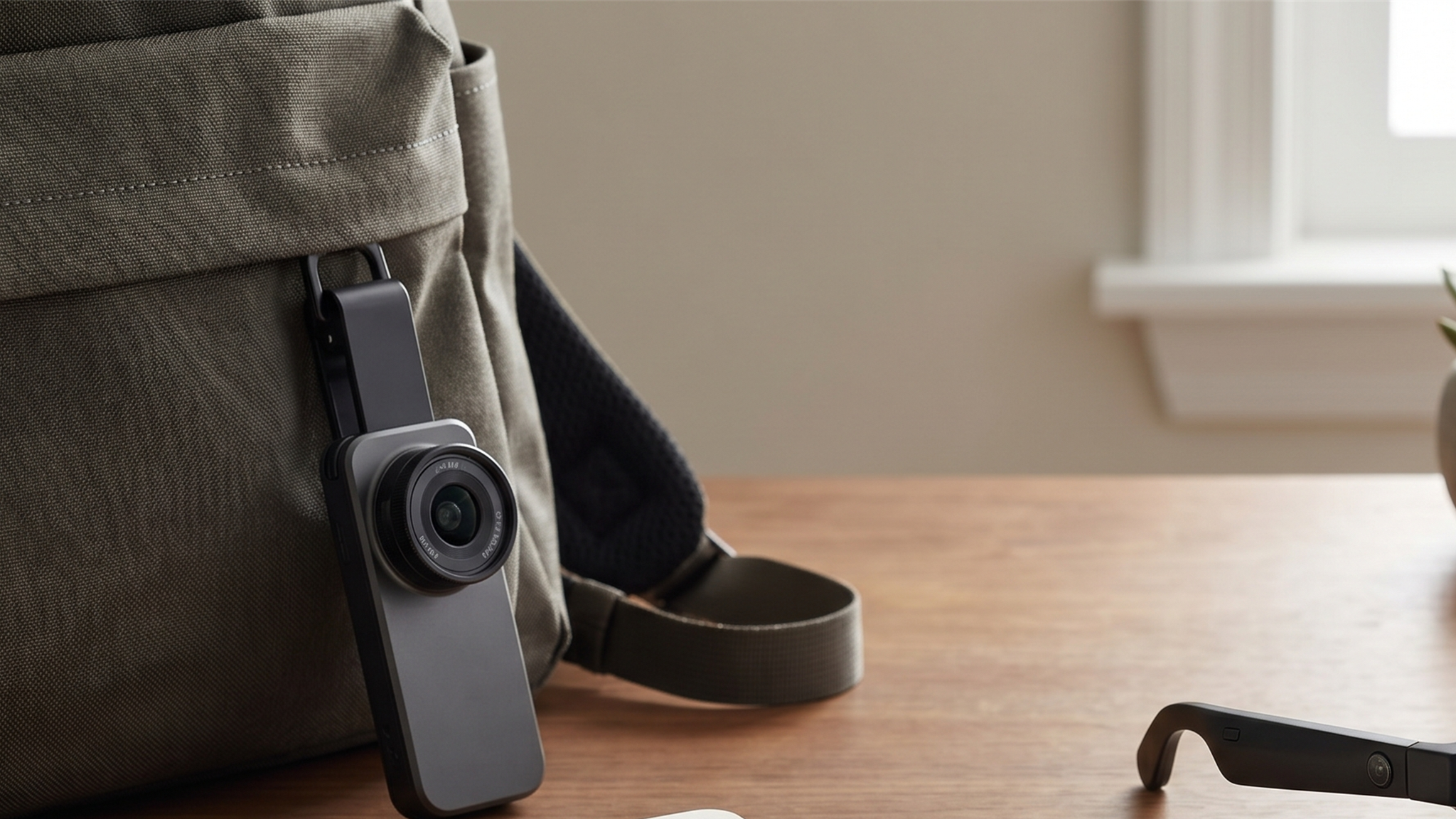
The best wearable cameras for travel are not the cameras with the loudest spec sheet. Travel journaling is a strange job: the camera has to be ready before the moment, small enough that you do not leave it in the hotel, honest enough that strangers understand when recording is happening, and simple enough that the files do not vanish into an app after the trip. A travel camera should help you remember a place without turning the trip into a production day. For most people in 2026, that means a tiny clip camera first, smart glasses second, and a rugged action camera only when the itinerary actually needs one. This guide ranks the practical options with a bias toward cloud-optional workflows, easy backups, and footage you can still open years later.
Why travel wearables matter now
Travel is where wearable cameras make the most sense and the most trouble. The sense is obvious: your hands are full, your route is changing, and the small moments matter more than the postcard angles. A phone is still the best camera you own, but it interrupts the scene. A wearable keeps the scene moving.
The trouble is also obvious. Travel puts you around strangers, children, security staff, museums, border controls, and local norms you may not understand. A camera on your chest or face is not just a gadget. It is a social signal. This is why we prefer visible, controllable capture over passive surveillance fantasies. The point is to journal, not to record every person who happened to stand near you.
The 2026 market is better than it was. Insta360’s GO 3S store page positions the camera around 4K capture and a small magnetic form factor. Ray-Ban’s official Meta glasses page shows how far smart glasses have come for short POV capture. GoPro’s HERO13 Black launch page and DJI’s Osmo Action 5 Pro specs cover the action side. The best pick depends on the trip, not the brand.
What to evaluate before buying
Start with mounting. A camera you can clip to a shirt is different from one you mount to a chest harness. Smart glasses are different again because the camera goes wherever your face goes. For travel journaling, flexibility matters more than maximum resolution. A magnetic clip, hat mount, pendant, or tiny stand lets you capture breakfast, train windows, walking routes, and hands-on moments without rebuilding a rig.
Battery is next. Manufacturer battery figures are lab conditions. Travel is not. Heat, cold, Wi-Fi transfer, stabilization, and screen use all reduce runtime. DJI officially lists up to 240 minutes under controlled 1080p conditions for the Osmo Action 5 Pro; that is impressive, but it is not the same as 4K travel capture with screens and stabilization. GoPro’s HERO13 Black announcement says the redesigned battery improves runtimes, but the practical travel answer is still: bring spares or power.
Storage matters more than people think. Internal storage is convenient until it fills on a day without a laptop. microSD is boring until a card fails. The safer workflow is nightly copy plus card rotation. If your trip matters, do not wait until you fly home to discover a transfer problem.
Finally, evaluate cloud dependence. A travel journal is exactly the kind of thing people leave inside an app because the app makes a pretty highlight reel. Export the originals. Put them in your Storage & Backup workflow when you return.
Comparison table: ranked travel wearable cameras
| Rank | Camera | Best travel role | Cloud posture | Main compromise |
|---|---|---|---|---|
| 1 | Insta360 GO 3S | Tiny clip camera for daily travel journaling | Optional | Short core battery without the Action Pod |
| 2 | Ray-Ban Meta | Smart-glasses POV photos and short clips | Account-centered | Privacy and clip-length limits |
| 3 | DJI Osmo Action 5 Pro | Long action sessions and wet travel days | Optional | Larger than a casual lifelogger |
| 4 | GoPro HERO13 Black | Rugged mount ecosystem and sports | Optional | Bulkier and shorter battery than DJI |
| 5 | Phone plus strap | Lowest-cost fallback | Depends on phone cloud | Social friction and battery drain |
Affiliate disclosure: This page contains affiliate links. If you buy through them, we may earn a small commission at no extra cost to you. It never changes what we recommend. As an Amazon Associate I earn from qualifying purchases. Read more.
Ranking and workflow
1. Insta360 GO 3S: best overall for travel journaling
The GO 3S is the best travel wearable because it is small enough to come with you on the ordinary parts of a trip. That sounds obvious, but it is the whole category. A heavy camera stays in the bag. A tiny magnetic camera gets used while ordering coffee, walking through a side street, or recording the hands-on parts of a day.
The form factor also supports more honest travel footage. You can wear it visibly, mount it on a hat, clip it to a backpack strap, or set it down for a short table shot. It is not as invisible as glasses, which is a privacy advantage in crowded places. The core weakness is battery. Treat the Action Pod as part of the system, not an accessory.
Use it like this: record short sequences, not entire days. Copy files nightly. Keep the app for edits, but store originals outside the app.
2. Ray-Ban Meta: best smart-glasses travel capture
Ray-Ban Meta is the best travel pick when the job is quick POV, not footage production. You can photograph a market stall, record a few seconds of a street musician where permitted, translate or ask questions with the assistant, and keep your hands free.
The downside is the account relationship. The glasses are part of Meta’s ecosystem, and Meta’s AI system card is worth reading because it explains how captured images and spoken inputs can be used for AI features. If that makes you uncomfortable, listen to that discomfort.
The other downside is social. Glasses are discreet. Discreet cameras require more restraint, not less. Use them for your own perspective, not for silently collecting strangers.
3. DJI Osmo Action 5 Pro: best for long travel sessions
The Osmo Action 5 Pro is what you buy when the trip includes hiking, biking, snorkeling, rain, or long chest-mount sessions. DJI’s official specs list a 1/1.3-inch sensor, 4K/120 recording modes, 20 m waterproofing without a case, 64 GB built-in storage with microSD expansion, and a controlled-condition battery claim up to 240 minutes. That is a real travel advantage.
It is not the best daily journal camera because it looks and feels like an action camera. That is fine. Use it where that clarity helps: trails, water, bikes, snow, and sports.
4. GoPro HERO13 Black: best rugged ecosystem
GoPro remains the mount ecosystem default. HERO13 Black adds magnetic latch mounting, HB-Series lens support, 5.3K/60, 4K/120, and a redesigned Enduro battery according to GoPro’s official announcement. If you already own GoPro mounts, the switching cost to DJI is real.
For travel journaling, GoPro is better as a planned session camera than an all-day wearable. Put it on for the ride, the hike, or the boat. Take it off for the museum.
5. Phone plus strap: best no-buy option
The boring answer is still useful. A phone lanyard, a small tripod, and a disciplined backup routine can beat a new camera you never learn. The phone has the best sensor and the simplest sharing path. It also creates the biggest social interruption. Use this option if budget matters more than hands-free capture.
The travel workflow we would actually use
For a one-week trip, pack the camera, one small power bank, one short USB-C cable, and either a laptop or a portable SSD that can receive files through your phone. Do not rely on hotel Wi-Fi as the backup plan. Hotel Wi-Fi is for messages and maps, not for pushing 200 GB of 4K clips before checkout.
Each night, copy the day’s files into a dated folder: 2026-07-14-kyoto-walk, 2026-07-15-train-to-osaka, and so on. Keep the card or camera storage untouched until that copy exists. If the camera app generates an auto-edit, save it as a derivative, not as the only version. When you get home, move the folders into your main archive before making a highlight reel. This is not glamorous travel advice, but it is the difference between a memory and a vanished app cache.
The same habit also makes editing easier. You can open a folder and know what happened that day. You are not hunting through a vendor gallery, a phone camera roll, and three social apps trying to remember where the best clip went.
One more travel note: turn the camera off before security, museums, religious sites, and border areas. A wearable camera that is technically allowed can still create an avoidable conversation. Pack it like camera gear, not like jewelry.
Best fit by travel use case
For city travel, pick the GO 3S or Ray-Ban Meta. The GO 3S is better if you want files and flexible mounting. The glasses are better if you want quick hands-free moments and open-ear audio.
For hiking, cycling, snow, or water, pick DJI or GoPro. DJI wins on battery and low-light practicality. GoPro wins on mounts and familiarity.
For family trips, prefer visible cameras. A chest-mounted action camera or clipped GO 3S is easier to explain than smart glasses. Kids and relatives deserve to know when capture is happening.
For creators, bring two devices: a phone for hero shots and a wearable for POV. The wearable should not carry the whole trip. It should catch the angle your hands cannot.
Privacy and backup note
Travel footage is full of people who are not on your trip. Record less in tight indoor spaces. Avoid filming security lines, border areas, hospitals, schools, and private ceremonies. When in doubt, ask.
At night, copy footage before charging everything. Keep one copy on the camera or card and one on a phone, laptop, or SSD. When you get home, fold the trip into your main archive and read Wearable Camera Privacy, Compare Cameras, and the Memory Tech Brief before the next trip.
Frequently asked questions
What is the best wearable camera for travel journaling?
The Insta360 GO 3S is the best fit for most travel journaling because it is tiny, mountable, and cloud-optional. Ray-Ban Meta is better for quick social POV moments, while GoPro and DJI are better for deliberate action sessions.
Are smart glasses good for travel videos?
They are good for short, hands-free clips and quick photos. They are not ideal for long walking videos, rain, water, chest-mount footage, or a local-first archive.
Should I bring a GoPro or a tiny camera for travel?
Bring a GoPro or DJI action camera if the trip includes sports, water, cycling, or rugged mounts. Bring a tiny camera if the trip is mostly city walks, museums, food, family moments, and daily journaling.
How should I back up travel wearable-camera footage?
Copy cards or internal storage every night to a phone, laptop, SSD, or travel router. Keep the camera media untouched until the second copy exists, then sync to cloud when bandwidth is available.