Wearable & Lifelogging Cameras
Body Cameras for Creators: Are They Actually Useful?
Police-style body cameras have a creator following now. Here's where they make sense, where they don't, and what to consider before you strap one on.
The phrase “body cam” used to mean one thing: a chunky chest-mounted recorder on a police officer’s uniform. In 2026 it means at least four things, depending on who’s typing it into a search bar. Cyclists want one. Dog walkers want one. Solo vloggers who don’t want to hold a camera want one. The hardware they actually end up buying is rarely a real body cam.
So let’s draw the line, and then talk about who should cross it.
What “body cam” even means now
A true body camera is purpose-built for evidence: chain-of-custody firmware, a giant tactile record button, an LED you can see from across a parking lot, and battery measured in shifts, not hours. Axon and Reveal sell these to police departments. A handful of consumer-facing brands sell similar units to security guards and rideshare drivers.
A chest-mounted action camera is something else. It’s a GoPro or a DJI Osmo strapped to a harness. Image quality is much higher. Battery is much shorter. The record button is buried in a touchscreen menu. The footage is meant to be edited and posted, not subpoenaed.
Both end up on chests. Only one is a body cam.
When a true body cam wins
Three scenarios. First, anything where you genuinely need an all-day record — rideshare drivers, security creators, late-night cyclists who want a witness on their commute. A real body cam will run an eight-hour shift on a charge. An action cam will not.
Second, anything where you need to flip recording on without thinking. The big mechanical record button matters when adrenaline is up.
Third, social profile. A boxy black slab on your chest reads as “this person is recording” to almost everyone who sees it. That’s good. Ambiguity is what gets creators into arguments with strangers.
When an action cam wins
For most creators reading this, the action cam wins on the things that actually matter to the channel: image quality, color science, mounting flexibility, and footage you’d want to put on YouTube. A police-style body cam shoots flat 1080p that looks like a parking-lot still from the local news. That isn’t a knock — it’s the design target. It just isn’t your design target.
If you want chest-mounted POV that you’ll actually edit, you want one of two cameras.
Our pick if you want a small chest-mounted action cam

Insta360 GO 3S
The closest modern relative to the Narrative Clip's everyday wearability — 4K, magnetic clip, and a separate dock for longer captures.
Best for: Hands-free lifelogging and POV creators who want the smallest possible 4K camera.
Review note: The strongest Narrative Clip-style recommendation because it combines a tiny magnetic body, usable 4K footage, and an offline file workflow when you want one.
Pros
- Pebble-sized, ~39 g — clips magnetically through clothing
- 4K/30 video and FlowState stabilization
- Action Pod dock works as a remote viewfinder and extends battery
- IPX8 splash and shallow-water rating on the core unit
Cons
- Battery on the core unit is short on its own — best paired with the dock
- Wide fixed lens; no optical zoom
- Editing flow assumes the Insta360 app
The GO 3S is the closest thing in 2026 to a wearable that disappears. It clips magnetically through a shirt, weighs about 39 grams, and shoots 4K. The core unit’s battery is short — that’s the trade — but the Action Pod dock buys back hours and doubles as a viewfinder. For dog walkers and lifelogging-curious vloggers, this is the sweet spot.
Our pick if you want a rugged build with a real battery
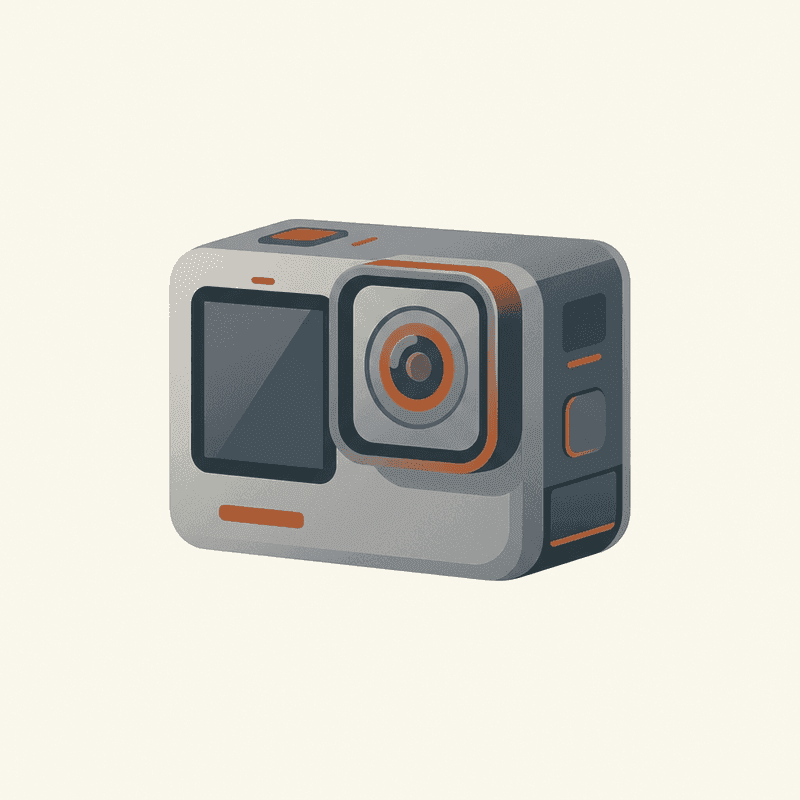
DJI Osmo Action 5 Pro
The longest-battery action camera in its class with strong low-light performance — a real GoPro alternative.
Best for: Creators who shoot long sessions and want better battery and low-light than GoPro.
Review note: The action-camera pick for longer recording sessions, especially when battery life and lower-light performance matter more than GoPro accessory breadth.
Pros
- 4K/120, 1/1.3" sensor with good dynamic range
- Real-world battery ~3+ hours at 4K/30
- Front and rear OLED touchscreens
- Magnetic quick-release mount
Cons
- Heavier and chunkier than the GO 3S
- Accessory ecosystem smaller than GoPro
- Cloud features tied to DJI Mimo app
If “body cam” to you means “I want this to survive winter, low light, and a three-hour shoot without panicking about battery,” the Osmo Action 5 Pro is the pick. Real-world battery is about three hours at 4K/30, the 1/1.3” sensor handles dusk and indoor light better than the GoPro, and the magnetic quick-release works with a chest harness. It’s heavier than the GO 3S. It will not disappear into your shirt. That’s the deal.
Why we don’t list a dedicated police-style body cam
We get asked. We’ve looked. The honest answer: most dedicated body cams sold to consumers are designed around an evidence-management ecosystem we don’t think creators should buy into. The firmware is locked, the footage workflow is built for prosecutors rather than editors, and the privacy implications of wandering around with a uniformed-officer-looking device pointed at strangers are different from wandering around with a GoPro.
There’s also a practical problem. The good body cams are expensive and locked behind agency sales channels. The cheap ones on Amazon are mostly rebadged dashcams with a clip on the back. We’d rather recommend a real camera you’ll keep using.
The legal layer
Two pieces of homework before you wear any of this in public. Read our guide to wearable camera privacy and consent for the etiquette and state-by-state shape of the rules. Then read is lifelogging legal for the longer view on what daily, continuous capture looks like in front of a court.
A body cam doesn’t grant you new legal rights. It mostly raises the stakes on the ones you already have.
Frequently asked questions
Are body cameras legal for creators to wear in public?
In most U.S. states, yes — recording video in public spaces where there's no reasonable expectation of privacy is generally legal. Audio is where it gets thorny: a dozen or so states require two-party consent. Check your state's wiretap statute before you flip the switch.
What's the actual difference between a body cam and an action cam?
A true body cam is built around evidentiary use: long battery, big record button, locked-down firmware, usually a chest mount, often no Wi-Fi by design. An action cam like the GoPro HERO 13 or DJI Osmo Action 5 Pro prioritizes image quality, mounting flexibility, and shareable footage. The line is fuzzy in 2026 because creators have started chest-mounting action cams and calling it the same thing.
Can you use a GoPro as a body cam?
Yes, with a chest harness or magnetic clip mount. You give up the all-day battery a real body cam offers — a HERO 13 is realistically 1 to 1.5 hours at high settings — but you get sharper footage and an editing path that doesn't involve evidence-management software.
Do body cams record audio?
Most do, and that's the legal gotcha. Audio consent laws are stricter than video laws in many jurisdictions. If your camera records sound and you're in a two-party-consent state, you can be on the wrong side of the law without realizing it. Some creators run the cameras muted on purpose.
Are body cams obvious to other people?
A chest-strapped GoPro is hard to miss, which is generally a feature, not a bug — it lowers ambiguity about what you're doing. A pebble-sized Insta360 GO 3S clipped through a shirt is much less obvious, and that's where the etiquette load shifts onto you.