Narrative Clip Archive
Narrative Clip Review: A Retrospective on the First Lifelogger
A retrospective review of the Narrative Clip 1 and Clip 2 — what worked, what didn't, and whether owning one in 2026 is anything but nostalgia.
The Narrative Clip is a 36 mm square of plastic and silicon that lived on the front of my shirt for most of 2014. It weighed about as much as a poker chip. The clip on the back was metal, sharp at the edges, and bit into denim and cotton with conviction. You forgot it was there within ten minutes. That, more than the megapixels or the cloud, was the actual point.
This is a retrospective. The Clip has not been manufactured for a decade. The company that made it folded, the successor wound down the service, and the cloud went dark in 2016. So why review it now? Because people still ask. Because used units still trade on eBay. Because a few of us miss the idea of it and would like to be honest about what the device actually was.
The Clip 1 in the hand
The Clip 1 launched in 2014 at $279. It was the size of a postage stamp folded in half. The body was a single piece of injection-molded plastic, available in orange, gray, and white. There was no display. There was no obvious button. There was a tiny pinhole lens in one corner and a status LED behind a frosted panel. You tapped it twice to force a photo. You charged it via USB. That was the whole interface.
I wore mine clipped to a shirt placket, the kind of spot a name tag would go. It sat well there. On a heavier coat lapel it tilted forward and shot the ground; on a thin t-shirt it pulled the fabric down and shot my own collar. There was a learned skill to wearing it that nobody talked about. The first week was mostly a study in where on your body the Clip would actually look at the world.
Compared to wearing nothing, it was a small, constant awareness. Compared to wearing a GoPro on a chest harness, it was invisible. That was the trade. You got a camera you would actually wear all day, in exchange for a camera that could not really see in low light, hold focus on anything close, or record sound.
The Clip 2 and what changed
Narrative announced the Clip 2 in February 2015 and started shipping it late that year and into 2016. The introductory price was $199. The headline upgrades were an 8 MP sensor, a wider field of view (around 86 degrees), short video clips, Wi-Fi, Bluetooth, and GPS. Battery life dropped from about two days to about 30 hours, which the company framed as a deliberate trade for the new radios.
The Clip 2 was a better camera. Wider lens meant fewer photos of my own chin. GPS meant the timeline knew where you had been without having to scrape your phone. Wi-Fi meant you could finally see today’s photos on the phone instead of waiting for a desktop sync.
It was also a slightly fussier object. The new radios chewed the battery. Photos took longer to leave the device. And — this part is hard to disentangle from the company’s broader collapse — the cloud-side processing that made the Clip 1 magical started to feel slower and less reliable on the Clip 2 right as Narrative ran out of money.
Two photos a minute, all day
Here is the rhythm. You wake up. You clip it on while the coffee brews. It takes a photo at 7:31, then 7:32, then 7:33, and on through your morning. You forget about it. You meet a friend for lunch and remember once, somewhere around the second beer, that the thing is recording. You unclip it before you go to the bathroom. (You learn this on day two.) You plug it in at night. You sleep. The cloud thinks while you sleep.
The first time you uploaded a day’s worth was magical. There you were, mid-laugh in a coffee shop, from an angle no one ever takes pictures of you from. There was the back of your friend’s head, lit warm. There was an entire frame, taken at 4:17 pm, of light hitting a kitchen table in a way you would have walked past forever otherwise.
The hundredth time you uploaded a day’s worth was mostly photos of your lap. Of the inside of a coat. Of a desk, from above, for four straight hours. The Clip did not know what was interesting. The cloud was supposed to, and it sort of did, and that was the actual product.
The app, the cloud, the magic that is gone
The Narrative companion app, on iOS and Android, was where you lived. It showed your day as a timeline. It surfaced “moments,” its name for clusters of similar photos that the server had decided belonged together. It generated rough auto-albums. You could search. You could share an individual photo to friends. It was very simple and, in 2014, slightly future-shock-inducing.
All of this ran in the cloud. The Clip itself had no concept of what a “moment” was. It was a sensor and a battery; everything else lived on Narrative’s servers in Sweden and, later, with the AWS infrastructure they migrated to. When Narrative and Third Dot announced the shutdown in late 2016 and gave users a window to download their archives, what they were actually retiring was the interesting half of the product.
What is left, today, is a device that takes photos and a USB cable. You can still pull the JPEGs off a Clip if you have the right adapter. You cannot get the albums back. You cannot get the search back. You cannot get the timeline view back. The app stores have long since dropped the listings.
Photo quality, plainly
Five megapixels on the Clip 1. Eight on the Clip 2. A small sensor in both, a fixed focus, a fixed aperture, no stabilization, and a slow electronic shutter when the light dropped.
Outdoors, at noon, on a clear day, the Clip took genuinely lovely photos. Slightly flat color. Pleasant wide framing. A documentary-photographer feel that I think had less to do with the lens and more to do with the angle: nobody poses for a camera on your sternum.
Indoors at night the Clip was useless. A restaurant scene came back as a smear of warm color. A friend’s face across a dinner table, at six in the evening in November, came back blurred unless they happened to stop moving at exactly the right 30-second tick. There was no flash. There was no way to ask for a re-shot.
If you want a single line: the Clip was a good camera for the things you don’t usually photograph, and a bad camera for the things you would.
The privacy footprint
The Clip was small, deliberate, and quiet. There was no obvious recording indicator. The LED was tiny and recessed. People around you, in almost all situations, had no idea they were being photographed every 30 seconds.
This was the Clip’s problem and its appeal in equal measure. The appeal was that it disappeared. You got an honest record of your day, not a curated one, because nobody — including you — was performing for the lens. The problem was that the people in your frames had not consented, in the way that “agreed to be in a Snapchat” is consent, to be in your archive at all.
Narrative published an ethics post in 2014 acknowledging the question. They did not solve it. They could not have, really; the shape of the device was the shape of the problem. We think anyone wearing one today, secondhand, should still be quiet about it in private spaces, ask before clipping in at dinner, and unclip in bathrooms, locker rooms, and other people’s homes by default.
2026 verdict
Do not buy a used Narrative Clip to use. The cloud is gone. The app is gone. The thing that made the Clip a Clip is gone, and what you would be paying for on eBay is a JPEG generator with a clip on the back.
Buy one as an artifact if you like. They are interesting little objects. The industrial design holds up. The story it carries — Kickstarter, Sweden, ~$550,000 raised, two years of shipping delays, a quiet shutdown — is a useful one to keep on a shelf.
If you actually want what the Clip promised, the closest modern equivalent in form factor is the Insta360 GO 3S; the closest in spirit (a wearable that disappears) is Ray-Ban Meta. Neither is a one-to-one replacement, and we say that without much pleasure.

Insta360 GO 3S
The closest modern relative to the Narrative Clip's everyday wearability — 4K, magnetic clip, and a separate dock for longer captures.
Best for: Hands-free lifelogging and POV creators who want the smallest possible 4K camera.
Review note: The strongest Narrative Clip-style recommendation because it combines a tiny magnetic body, usable 4K footage, and an offline file workflow when you want one.
Pros
- Pebble-sized, ~39 g — clips magnetically through clothing
- 4K/30 video and FlowState stabilization
- Action Pod dock works as a remote viewfinder and extends battery
- IPX8 splash and shallow-water rating on the core unit
Cons
- Battery on the core unit is short on its own — best paired with the dock
- Wide fixed lens; no optical zoom
- Editing flow assumes the Insta360 app
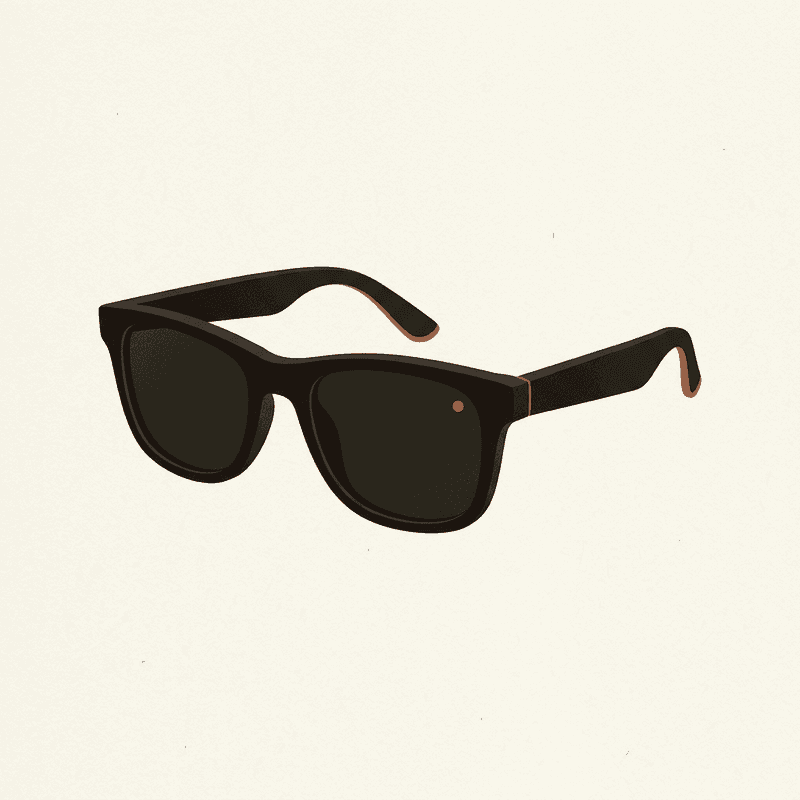
Ray-Ban Meta Smart Glasses
A socially acceptable hands-free camera you can wear daily — quality is good, but cloud and AI features lean on Meta accounts.
Best for: Daily wearers who want POV photos and short clips without holding a camera.
Review note: The best daily-wear option for quick POV photos and short clips, held back by Meta account dependence and limited local-first control.
Pros
- 12 MP ultrawide; up to 1080p video
- Capture LED signals recording to bystanders
- Works as Bluetooth headphones and AI assistant
- Looks like normal sunglasses
Cons
- Short clips only; not designed for hours of continuous capture
- Tied to Meta View app and account
- Limited control over local-only workflows
Buy this instead
Compare wearable cameras
Swipe sideways to see all columns →
| Camera | Best for | Resolution | Battery | Mounting | Cloud | Approx. price | Buy |
|---|---|---|---|---|---|---|---|
| Insta360 GO 3S Insta360 | Hands-free lifelogging and POV creators who want the smallest possible 4K camera. | 4K/30 | 0.65 h | Magnetic clip | Optional | $400 | Check price ↗ |
| GoPro HERO 13 Black GoPro | Creators who need a single durable camera for vlogs, sports, and occasional hands-free use. | 5.3K/60 | 1.5 h | Multi-mount | Optional | $400 | Check price ↗ |
| DJI Osmo Action 5 Pro DJI | Creators who shoot long sessions and want better battery and low-light than GoPro. | 4K/120 | 3 h | Multi-mount | Optional | $350 | Check price ↗ |
| Ray-Ban Meta Smart Glasses Ray-Ban / Meta | Daily wearers who want POV photos and short clips without holding a camera. | 1080p/30 | 4 h | Glasses | Required | $300 | Check price ↗ |
| AKASO Brave 7 AKASO | Budget-conscious buyers and first wearables for kids/family. | 4K/30 | 1.5 h | Multi-mount | Optional | $140 | Check price ↗ |
| DJI Osmo Pocket 3 DJI | Travel vloggers who want stabilized, low-light-capable footage without a wearable. | 4K/120 | 1.6 h | Multi-mount | Optional | $520 | Check price ↗ |
Prices and specs are publisher estimates — verify at the retailer before buying.
The Clip wasn’t bad. It was lonely on the market, and the market caught up to it from a direction (smartphones, then smart glasses) it could not outrun. We miss it. We do not recommend it.
Frequently asked questions
Is the Narrative Clip worth buying in 2026?
Not as a camera you actually use. The cloud service that did the real work — album generation, search, the timeline — has been offline since 2016. A used Clip is a curio, and a fair one at that, but it will not give you the experience the original owners had.
What's the difference between the Narrative Clip 1 and Clip 2?
The Clip 1 (2014) was 5 MP, USB-only, and shot a still photo every 30 seconds. The Clip 2 (announced 2015) was 8 MP with a wider lens, added Wi-Fi, Bluetooth, GPS, and short video clips, and shipped at $199 introductory. Battery life on the Clip 2 was roughly 30 hours; the Clip 1 ran for around two days on typical use.
Does the Narrative app still work?
No. The app is non-functional without the cloud, and the cloud was shut down by Narrative and its successor Third Dot in 2016. There is no current way to sign up for a new Narrative account or restore an old archive.
What was the photo quality really like?
Modest at best. The 5 MP sensor on the Clip 1 was a fixed-focus wide angle with no stabilization and a slow shutter. Outdoors in good light, results were flat but pleasant. Indoors after sunset, you got mostly blur. The Clip 2's 8 MP sensor helped, but the limits were the same.
Are there other Narrative Clip reviews from when it was new?
Yes. Engadget, The Verge, Wired, and TechCrunch all covered the original Clip between 2013 and 2015, and there are first-person blog posts from early backers still floating around the open web. We link out to a few in our archive when we can confirm the source has not link-rotted.