Narrative Clip Archive
Narrative Clip and Privacy: Lessons Not Learned
A camera that quietly took two photos a minute, all day, with no obvious recording indicator. Why the Narrative Clip's privacy posture mattered then and matters now.
Walk into a coffee shop wearing a GoPro on a chest harness and everyone notices. Walk into the same shop wearing a Narrative Clip on your shirt and nobody notices anything. Same outputs. Wildly different social contracts. That gap is the whole argument.
What the Clip did, and what it didn’t do
The original Narrative Clip captured one photo every 30 seconds for as long as you wore it. Two a minute. Roughly 6,000 in a charge. A 5 megapixel sensor on a 36 mm square of plastic, clipped through a shirt placket or a lapel. No display. No shutter button on the top edge. No audible click. And, importantly, no visible recording LED.
There was a tap feature, but it was a way to grab an extra frame on demand, not a way to tell a bystander something was being captured. The Clip’s design philosophy was that the camera should disappear. Mission accomplished.
The companion app and cloud handled the rest. Photos auto-uploaded when you plugged the Clip into a computer running the Narrative app, then the service organized them into “moments” using server-side processing on faces, scenes, and timestamps. Strangers’ faces, in many of those frames. Strangers who had not been asked.
The 2014 ethics post
Narrative themselves wrote about this. In 2014 the company published a public post arguing that wearable cameras created a new etiquette problem and that wearers had a responsibility to respect the people around them. Reading it now, in 2026, it is striking in two ways. It is genuinely thoughtful, in a way you rarely see from a hardware startup. And it solves nothing.
The post acknowledged the tension. It did not change the product. The hardware shipped without a recording indicator, then shipped again, in the Clip 2, also without one. The argument was: trust the wearer. The result was: the wearer was the only line of defense.
We do not think that line of defense is enough. It never has been.
What modern wearables do differently
The most interesting counter-example on the market right now is Meta’s glasses.
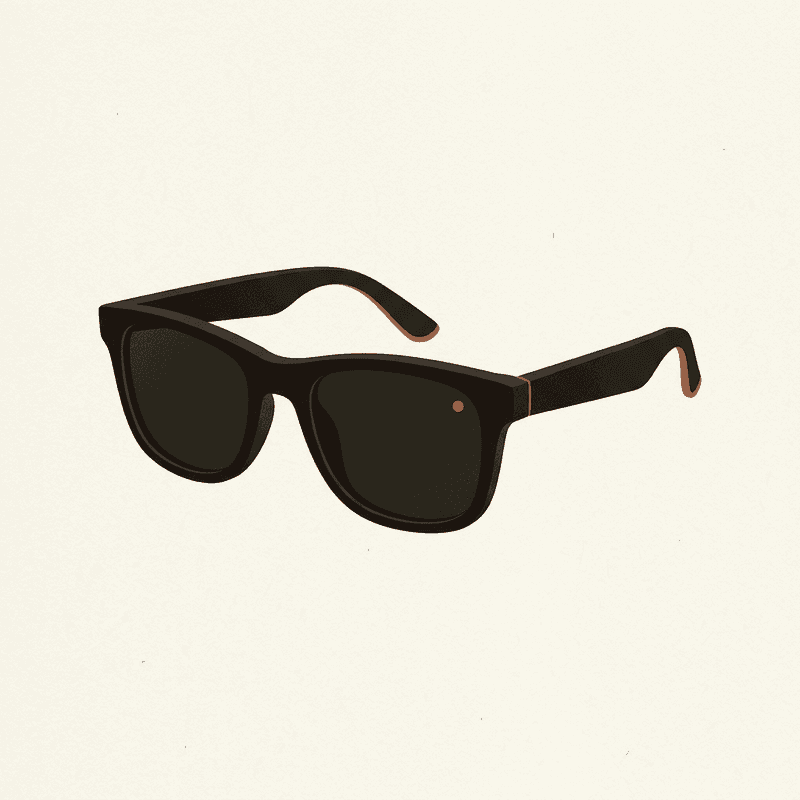
Ray-Ban Meta Smart Glasses
A socially acceptable hands-free camera you can wear daily — quality is good, but cloud and AI features lean on Meta accounts.
Best for: Daily wearers who want POV photos and short clips without holding a camera.
Review note: The best daily-wear option for quick POV photos and short clips, held back by Meta account dependence and limited local-first control.
Pros
- 12 MP ultrawide; up to 1080p video
- Capture LED signals recording to bystanders
- Works as Bluetooth headphones and AI assistant
- Looks like normal sunglasses
Cons
- Short clips only; not designed for hours of continuous capture
- Tied to Meta View app and account
- Limited control over local-only workflows
The Ray-Ban Meta has a small white LED on the right temple that lights up the moment the camera is engaged. You cannot disable it without modification, and Meta has said it will not ship a firmware option to do so. Bystanders can see it. People who pay attention learn what it means. That is not a constraint that ruined the product. The Ray-Ban Meta sells, and it sells well, and it does so with a visible recording indicator. The lesson from the Clip is sitting on Meta’s industrial design spec.
The Insta360 GO 3S is small enough to inherit some of the Clip’s stealth problem, but the Action Pod dock most people actually use is conspicuously a camera. GoPros announce themselves visually before they announce themselves with a tally light. The DJI Osmo Action 5 Pro has front and rear screens that are themselves a signal: that thing is a camera, it is on, you can see your own face in the front display.
Visible recording indicators are not friction. They are part of the product.
What hasn’t changed
Plenty. Concealed-camera glasses are still sold on Amazon for $40. Lapel “spy” cameras are a category, not an exception. Pen cameras still exist. Body-worn cameras for civilians are now a normal accessory category in some countries.
The Clip’s hardware is dead, and its cloud has been off since 2016, but the design pattern it normalized is alive: tiny camera, no indicator, captures by default, sorts later. Every Kickstarter pitch for a “passive memory device” since has been a variant of the same idea. Most of them have made the same choice on the LED question, which is to skip it.
The consent obligation still lands on the wearer. The device still does the wearer no favors.
A short etiquette guide, if you wear one anyway
We are not telling you not to lifelog. We are telling you to be the consent layer the hardware refuses to be.
- If you are in a private home, tell the host before you walk in.
- If you are in a conversation, say it once and let the other person object.
- Take it off in bathrooms, locker rooms, medical offices, and schools. No exceptions.
- If somebody asks what it is, answer plainly. “It’s a camera. It takes a photo every 30 seconds. I can turn it off.”
- Do not upload identifiable photos of strangers to a cloud service for face-based sorting. The Narrative cloud is gone; the principle is not.
- Treat audio recording as a separate, harder question. Most jurisdictions do.
None of this is hard. It is the part the Clip’s makers wrote about in 2014 and then waved at. A decade later, the wave still doesn’t cut it.
Frequently asked questions
Did the Narrative Clip have a recording light?
No. The original Clip had no obvious LED that signalled it was taking photos. It captured one image every 30 seconds with no shutter sound and no visible indicator, which was the core of the consent complaint.
Is it legal to wear a lifelogging camera in public?
In most U.S. and EU jurisdictions, photography in genuinely public places is legal, but private property, bathrooms, locker rooms, and audio recording rules vary widely. Two-party-consent states treat audio differently than photos. Check your local law before you wear one indoors.
What did Narrative say about privacy?
Narrative published an ethics post in 2014 acknowledging the consent problem a tiny passive camera creates. They argued users should be thoughtful. They did not add a visible recording indicator to the hardware.
Are modern wearables better on consent?
Some are. Ray-Ban Meta has a required capture LED that lights up when filming or photographing. GoPros are visibly cameras. The Insta360 GO 3S is tiny, but its Action Pod dock is conspicuous. Hidden lapel cams and concealed-camera glasses still exist.
Should I tell people I'm wearing one?
Yes, in any setting where someone would reasonably expect not to be recorded. Houses, conversations, gyms, schools, medical offices. The wearer carries the consent obligation, not the device.